
Predictive maintenance for concrete & cement plants
How can a cement plant catch kiln and mill failures before they stop the line?
DHMSCare monitors rotary kilns, cement mills, vertical pumps, reducers and drive motors.
Integrated wireless vibration and temperature sensors sit on each machine.
A typical production line needs about 55–65 sensors on DMG310 gateways.
Its industrial AI agent watches every machine around the clock.
It tells your team which one needs attention, and why.
Industry challenges
Rotary kilns and cement mills are large rotating machines. A single failure on one of them carries a very high repair and production cost.
Reducers, gearboxes and other core drive components can fail suddenly. One such failure can shut down the entire production line.
High dust and high temperature around the kiln and mills make manual spot checks difficult. Some points are simply not checked as often as they should be.
When a machine misbehaves, it is hard to tell a mechanical fault from an electrical one quickly. A wrong first guess sends the repair crew in the wrong direction and delays the fix.
Quantifiable value
Monitoring solution
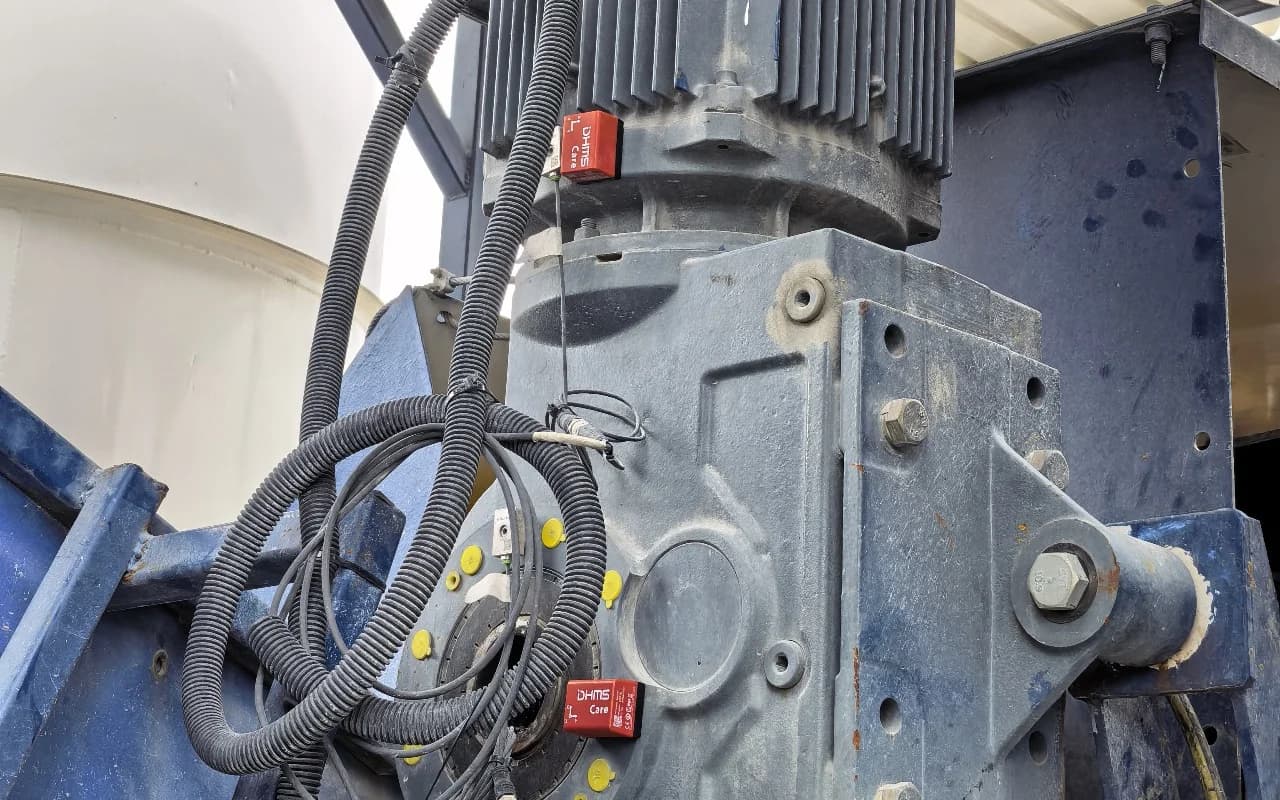
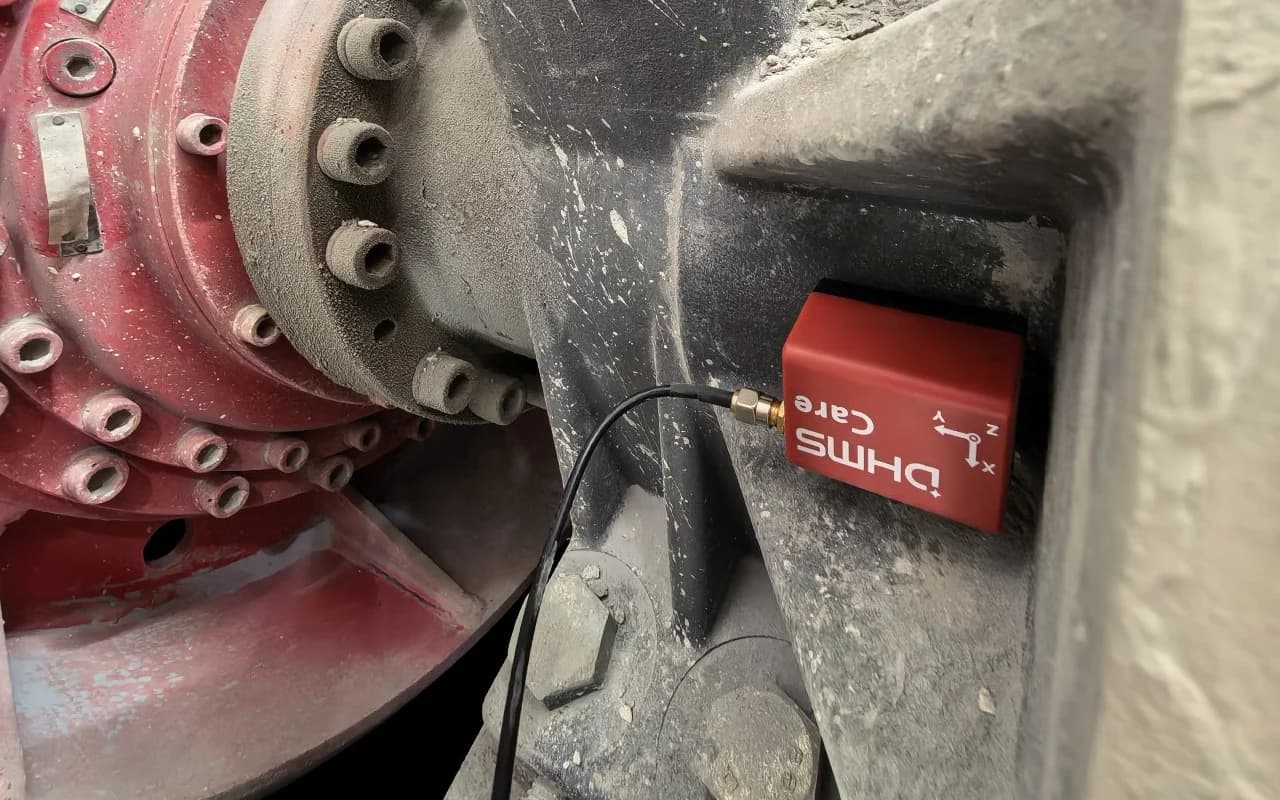
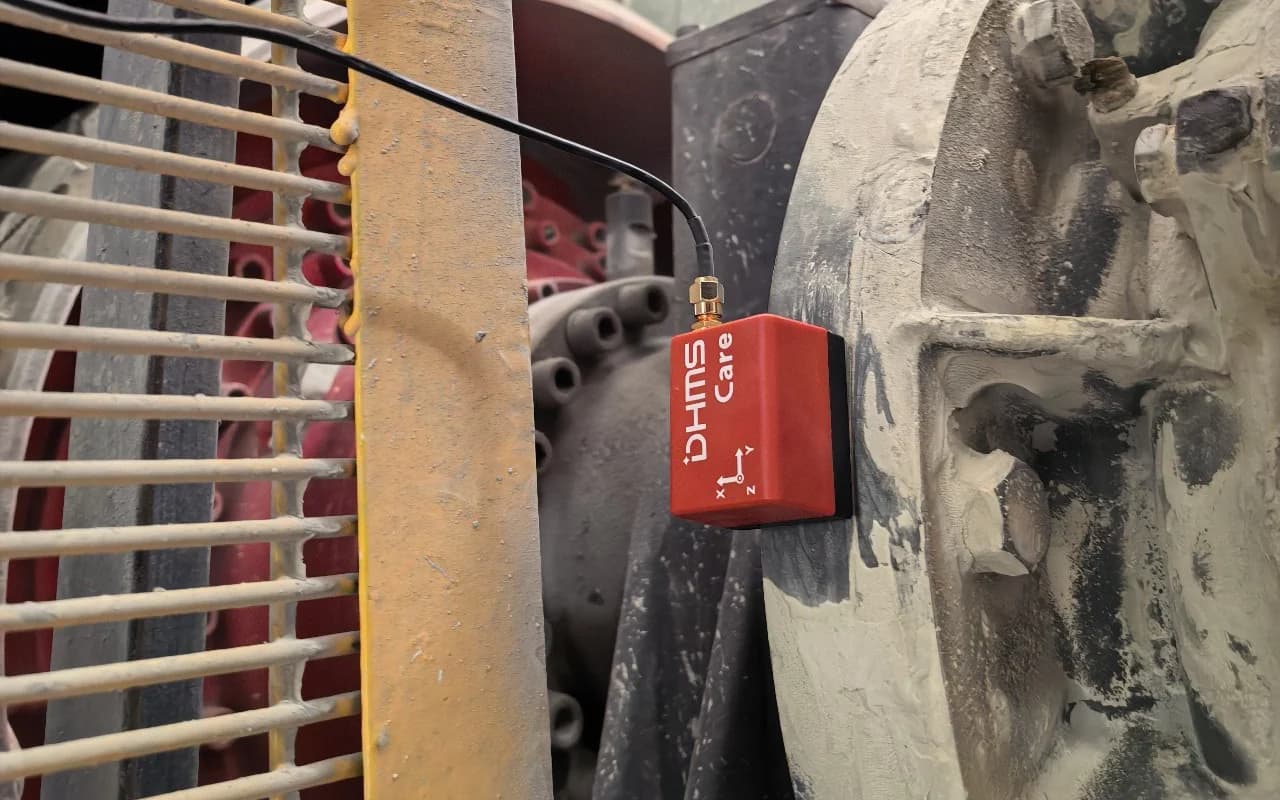
DHMSCare places sensors on the support-roller and drive bearings of the rotary kiln, and on the bearing seats of cement mills, vertical pumps, reducers and drive motors.
The sensors are wireless and IP69 rated, so no cable has to run through hot or dusty areas.
From the day of installation, DHMSCare gives 24/7 condition monitoring, AI fault diagnosis and health assessment, with no months-long learning period.
Platform
DHMSCare uses AI to identify early fault signs such as gear wear and bearing anomalies, assess equipment health and provide maintenance recommendations.
Recommended measuring points and plan
What a typical production line needs, so you can see the whole plan before we talk.
| Asset | Suggested sensors | Measuring points (bearing seats) |
|---|---|---|
| Rotary kiln | 14 | Support-roller bearing seats at each tyre station, plus the main drive and pinion bearings |
| Cement mill | 8 | Main motor DE and NDE, main reducer input and output, pinion bearings, feed-end and discharge-end trunnion bearings |
| Vertical pump | 3 per unit | Motor DE and NDE, plus the pump bearing housing |
| Reducer | 6 | Input, intermediate and output shaft bearings, on both sides |
| Drive motor | 3 per unit | Motor DE and NDE, plus the first bearing seat of the driven machine |
| Gateway | DMG310 | DMG311 (4G) where there is no Wi-Fi |
| Per production line | approx. 55–65 |
Actual quantities are confirmed on site
AI Care
The first plan with AI fault diagnostics, the AI that finds the gear wear and bearing anomalies behind these results.
Choose AI Care Plus for unlimited automatic diagnostics, remaining-life forecasts with Mina Ultra and 24 months data retention.
Smaller teams can start on Care: AI condition monitoring and daily reports with 10 user accounts, then move to AI Care when you need AI fault diagnostics.
Start with one line
The smallest sensible start, then grow line by line or roll out plant-wide.
Watch the machines you can least afford to stop.
You learn about faults days ahead.
All your lines, all sites, on one dashboard.
Tailored to your project's requirements.
Runs on your own servers or private cloud.
Contracted and delivered as a project.
Can DHMSCare monitor kiln drives, raw mills, cement mills and ID fans?
Yes. DHMSCare monitors cement-plant motors, gearboxes and fans, including mill drives and induced-draft fans; for slow kiln drives, tell us the shaft speed and we confirm the right sensor first. An induced-draft fan is the large fan that pulls hot gas through the kiln. DHMSCare monitors industrial motors and reducers at a concrete and cement group, and vertical pumps at a concrete producer; sensor surface contact is rated to 100 °C, and kiln shells need a heat check first.
Questions
We are a small or mid-sized company. Is this for us?
Yes. Start with one line and one gateway, subscribe per sensor per year, and begin on AI Care; Care if you only need condition monitoring.
How long does a one-line pilot take?
Installation follows the seven steps in our quick installation guide: create the equipment, mount the gateway, attach the sensors and bind the measuring points. We agree the pilot period with you by line size.
We have no vibration engineer. Can we still use it?
Yes. The AI identifies early fault signs, assesses equipment health and gives maintenance recommendations, and Mina tells you which machine to handle first and why.
How many sensors does a cement line need?
About 55–65 per line. That is 12–15 on a rotary kiln, 8 on a cement mill, 6 on a reducer and 3 per vertical pump or drive motor.
Do the sensors cope with cement dust?
Yes. Every DHMSCare wireless sensor is rated IP69, which means it is dust-tight. The sensors are wireless, so no cabling has to be routed through dusty areas.
Can DHMSCare tell a mechanical fault from an electrical one?
Yes. DHMSCare diagnoses down to the component, such as a bearing, gear, imbalance or misalignment. On motors it also flags electrical faults such as rotor-bar breakage and insulation degradation.

Tell us the line and its critical assets; we size the sensors and the plan with you.