
Four ways to monitor machine health — which one should you choose?
DHMSCare sits side by side with four common approaches.
The first two are sensor and bearing vendor monitoring and specialist vibration monitoring and diagnosis vendors.
The other two are industrial internet and software analytics platforms and local system integrators.
Every row is a question you would ask while choosing.
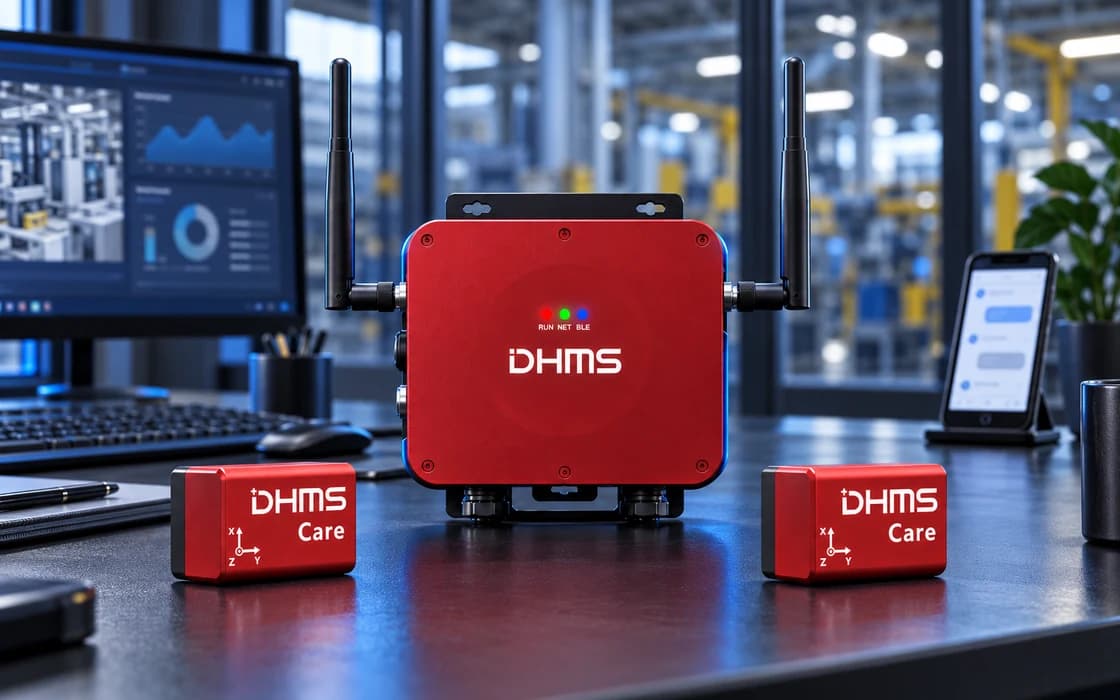
Online wireless monitoring or handheld route checks: how do you choose? →
How long from selection to go-live, and do we have to stop production? →
Sensor and bearing makers sell hardware with monitoring built in. Why add a separate system? →
There are plenty of cheap wireless sensors. Why choose DHMSCare? →
Point-by-point comparison
| DHMSCare | Sensor & bearing vendor monitoring | Specialist vibration monitoring and diagnosis vendors | Industrial internet and software analytics platforms | Local integrator, custom build | |
|---|---|---|---|---|---|
| Typical suppliers | DHMSCare | Bearing and sensor brands, Chinese and imported | Chinese vendors focused on vibration monitoring and fault diagnosis | Industrial internet platforms and equipment-health software | Local automation integrators and equipment service firms |
| Sensors & hardware | DHMSCare provides IP69 wireless sensors and IP65 gateways. Bluetooth mesh, sized per line — one order covers a line. | Usually offers its own sensors, or monitoring hardware built around bearings. Models follow its product line; cross-brand equipment needs extra matching. | Usually offers wireless vibration sensors with its own cloud platform. Hardware and software are sold as one set. | Usually provides no sensors. You source them and complete the integration yourself. | Usually procures third-party hardware per project. The integrator handles installation and commissioning. |
| Sizing & plans | DHMSCare publishes measuring points, counts and plans. Per machine, per line — read the plan before the first call. | Sales or engineers usually provide configuration advice per inquiry. The plan is confirmed project by project. | Sales or engineers usually provide configuration advice per project. The measuring-point plan is fixed at the contract stage. | You usually need to do the sizing yourself. The platform only handles data analysis. | Usually surveys the site first, then proposes a custom plan. The timeline depends on the survey schedule. |
| AI agent | Mina, DHMSCare's AI agent, diagnoses to the component level. Bearing, gear, unbalance, misalignment. It gives next steps and a re-inspection cadence, not just an anomaly flag. | Usually provides alerts and basic diagnostics. Deeper readings are mostly delivered as reports or manual services. | Mostly analyses with fault-mechanism models or AI. Diagnosis engineers give repair advice or a report. | Usually provides charts and alerts. Your team makes the judgment. | Usually provides periodic on-site inspection and reports under contract. No continuous automatic diagnosis. |
| Published specifications | DHMSCare publishes a spec sheet for every model: frequency response, measuring range, ingress rating, battery life. The full spec sheet is sent on request to your company email. | Key specifications usually appear in the datasheet. How much is public varies by vendor. | Key specifications usually appear in the datasheet or on request. How much is public varies by vendor. | Usually publishes a feature list. Sensor specifications depend on the hardware you choose. | Parameter details usually come in the quotation or contract. |
| Deployment & go-live | Sensors bond in place, gateways wall-mount, points pair with a tap. Verdicts arrive on install day — no months-long learning period. The go-live date is agreed by machine count. | Usually provides installation guidance with its own hardware. Or sends engineers on site. | Usually a site survey first, then deployment per project. When verdicts arrive varies by vendor. | You usually install the sensors and connect the data yourself. | Usually handles installation and commissioning completely. The timeline follows the project schedule. |
| Platform & data | Data stays on nodes inside the Chinese mainland and does not leave the country. One AI agent covers the mobile app, the web and the factory screen. | Usually carried by its own cloud service. | Mostly uploaded to the vendor’s cloud platform. Confirm the storage location per vendor. | Usually public-cloud SaaS. On-premises deployment needs separate discussion. | Local deployment is more common. Customised per project. |
| How you start | DHMSCare lets you start with one line. Industry pages give the minimum configuration. Then expand line by line once it runs. | Usually starts with batch purchases of equipment. | Usually starts with a contract by device scale or project. | Usually starts as a subscription, with hardware bought separately. | Usually contracts project by project. |
| Open integration | DHMSCare welcomes third-party sensor data. Southbound standard protocols plug and play; northbound APIs get the data into your systems. | Usually ingests data from its own sensors and gateways only. | Usually centred on its own sensors. Confirm third-party data access per vendor. | Usually relies on standard protocols; integration and governance are on you. | Usually builds custom integrations per project, with per-project cost and timeline. |
| Customisation & local deployment | DHMSCare customises and deploys locally. Proven at nearly 100 large enterprises*, privacy-protected. The whole AI agent runs on your premises*; data stays on site. | Usually sells standard products. Custom development and local deployment are limited. | Some support in-house or private deployment. Most offer data interfaces such as API or MQTT. | Usually supports local deployment. AI capability and customisation depth vary by vendor. | Custom development is its core. AI capability depends on the platform chosen. |
| Deployment | The platform runs on nodes inside the Chinese mainland, and data does not leave the country. Central and state-owned enterprise projects can run on-premises in the customer’s own server room. | Deployment speed and method vary; onboarding is usually handled by the vendor. | Usually diagnosed in the cloud; some compute at the edge on the sensor or gateway. Onboarding time follows the project. | Cloud software you set up yourself; timing depends on your own team. | Project-based rollout; the timeline follows the project scope. |
| Initial investment | DHMSCare starts with a single production line. Priced per plant by equipment and installation-point count; no local server required. | Initial spend depends on the hardware and plan chosen. | Prices are generally not published. Confirm the cost breakdown line by line in a quote. | Software licence plus your own hardware and setup effort. | Quoted per project; typically a larger upfront investment. |
| Implementation | Installation is carried out by DHMSCare’s 20+ person on-site implementation team, licensed for intelligent-electronics and electromechanical installation work. A photo of the equipment lets the AI agent help set up the asset record and plan measuring points. | Implementation is usually delivered by the vendor or a partner. | Most offer on-site support or deployment service. Confirm remote diagnosis hours and response per vendor. | Self-implementation; configuration effort is on you. | Implementation is the core of the engagement. |
Compiled from public product information. Each column summarises a category; each product’s own documents govern.
* Customised development and local deployment depend on project scale, and are delivered as a project after formal cooperation; not included during the trial. Contact us →
Hardware vendors bring their own sensors; specialist vibration vendors mostly have diagnosis engineers write reports; industrial internet platforms focus on gathering data; integrators deliver project by project. DHMSCare learns a baseline for each machine, diagnoses to the component level with next steps, and combines the hardware, the platform, the AI agent and 20+ certified diagnosis engineers in one system, with published specs, per-line sizing and a one-line start; data for customers in China stays on nodes inside the Chinese mainland, and central and state-owned enterprise projects can run on premises.
Questions buyers ask
What makes DHMSCare different?
DHMSCare combines wireless sensors, a monitoring platform and the Mina AI agent in one system: specifications are published, every line is sized on the industry pages, you can start with one line, and go-live is scheduled by machine count.
How do I choose a plan and get activated?
Submit an activation request on the plans page and we activate within 1 business day. For large projects and distribution partnerships, please contact us.
Does deployment stop production? How soon can we go live?
No machine modification is needed: sensors are bonded near the bearing seats, the gateway is wall-mounted, and each sensor is bound to its measuring point in the app with a tap. We agree the go-live date with you by the number of machines.
Which DHMSCare sensor do I need?
The DT310 for most rotating machines (0–6000 Hz), the DT311 where the machine sits inside an enclosed metal structure, and the DT400 or DT420 for high-g or variable-speed machines in open environments (±60 g, 0–8000 Hz).
Can it be customised or deployed on-premises?
Customisation, on-premises deployment and project-based delivery are all available; talk to our team about your plan. They are not available during the trial.
How long does the sensor battery last?
The DT300–DT321 sensors are rated for 5 years after activation; the DT400 and DT420 are rated for 3 years after activation.
How many sensors can one gateway serve?
The DMG310 serves up to 60 sensors with 60–80 m range in a typical plant (about 300 m line of sight); the DR100 repeater covers up to 20 sensors.
How does DHMSCare differ from specialist vibration monitoring vendors in China?
Three points: DHMSCare learns a baseline for each machine and compares it with itself, with ISO vibration zones only a reference at first install; the AI agent Mina writes the diagnosis report in one click, naming the suspect location, the likely fault type and the action, and 20+ certified diagnosis engineers review remotely; and DHMSCare’s own 20+ person on-site team installs, with data for customers in China kept on nodes inside the Chinese mainland.
How do I start on a small budget?
Start with a single production line, with no plant-wide retrofit: DHMSCare’s on-site implementation team installs it, and you expand line by line. Data stays on nodes inside the Chinese mainland, and central and state-owned enterprise projects can also run on-premises.
Explore plans and packages, or start with a trial.