
Predictive maintenance for rotary kilns
How do you catch an overloaded support roller before it damages the tyre and the kiln shell?
A rotary kiln turns slowly on support rollers that carry the whole shell.
Misalignment between shell and rollers loads the bearings unevenly and wears the tyres.
Sensors on the roller bearing seats track vibration and bearing temperature against the kiln's own baseline, and sensors on the drive read its full spectrum, so an overloaded roller is flagged before the shell pays for it.
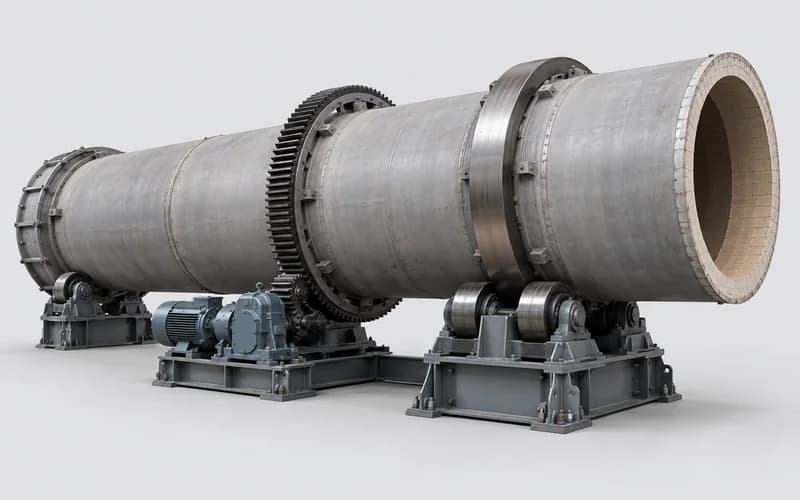
Typical faults
A support roller that sits off the kiln axis pushes extra load and thrust onto its bearings and wears the tyre unevenly. It shows as a sustained rise in roller bearing temperature and vibration against the kiln's own baseline.
Roller bearings carry the kiln weight and every alignment force. They turn too slowly for bearing-frequency peaks to show, so wear and lubrication problems are read as a rising bearing temperature and, as the damage grows, a rising impact level in the vibration, both against the kiln's own baseline.
The drive motor, gearbox and pinion turn fast enough for a full spectrum: unbalance, misalignment and bearing wear on the drive each show their own frequency signature.
Loose roller base bolts or worn mounting pads let the roller station move under load. It shows as a step or a steady rise in the vibration level at its bearing seats.
Where sensors go
Sensors are bonded next to the bearing seats — no machine modification. Each sensor is bound to its measuring point in the app with a tap, and the gateway is wall-mounted nearby.
DT310 wireless vibration and temperature, 3-axis, 0–6000 Hz. Use DT311, with an external antenna, where a point sits inside an enclosed metal structure.
DMG310 (Ethernet / Wi-Fi): up to 60 sensors each, 60–80 m range in a typical plant (about 300 m line of sight). DMG311 (4G / Ethernet) for sites without Wi-Fi.
How to read a typical spectrum
The support rollers turn too slowly for their own frequency lines to show in a capture, so on the roller stations DHMSCare reads the trend: vibration level and bearing temperature, sampled on a fixed schedule and compared with the kiln's own baseline. A sustained rise over weeks tells you when a roller needs re-setting, while the tyre still has life left. The drive motor, gearbox and pinion are read in the full spectrum.
Questions
How many sensors does one kiln need?
A typical start is 6: two on each of two support rollers, one on the drive, and one on the motor.
Does the kiln heat affect the sensors?
Sensors are bonded away from the shell surface at the bearing seats and are rated for industrial temperature ranges.
Which kiln should I monitor first?
The one you can least afford to stop — a kiln shutdown stalls the whole plant downstream.
Map the measuring points on your equipment before the first call.