
Predictive maintenance for reciprocating compressors
How do you catch a failing valve plate before a reciprocating compressor loses its discharge pressure?
A reciprocating compressor is a pulse machine: every stroke loads the valve plates, piston rings and crosshead, and each fault changes the impact signature.
DHMSCare sensors on the bearing seats read those impacts on a fixed sampling schedule, and the AI names the fault before the compressor loses capacity.
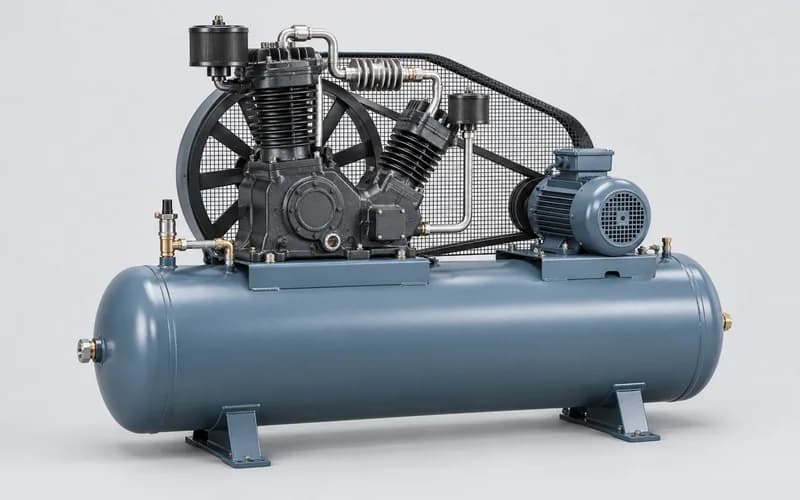
Typical faults
The suction and discharge valve plates open and close with every stroke. A cracked or worn plate changes the impact pattern and the compressor loses capacity before the failure is audible.
Worn piston rings let gas leak past the piston. The impact signature at the crosshead changes, and the compressor works harder for the same discharge pressure.
The crank and crosshead bearings carry every stroke. Wear raises the high-frequency noise floor, then adds discrete peaks at the bearing characteristic frequencies.
Loose bolts or a worn crosshead guide produce a train of harmonics at the running speed — the machine shakes more than it compresses.
Where sensors go
Sensors are bonded next to the bearing seats — no machine modification. Each sensor is bound to its measuring point in the app with a tap, and the gateway is wall-mounted nearby.
DT310 wireless vibration and temperature, 3-axis, 0–6000 Hz. Use DT311, with an external antenna, where a point sits inside an enclosed metal structure.
DMG310 (Ethernet / Wi-Fi): up to 60 sensors each, 60–80 m range in a typical plant (about 300 m line of sight). DMG311 (4G / Ethernet) for sites without Wi-Fi.
How to read a typical spectrum
A healthy reciprocating compressor shows a sharp impact at each stroke with its natural harmonics. When looseness or a worn guide develops, the harmonic train grows unevenly — the machine puts energy into shaking instead of compression. The AI reads that change against the compressor's own baseline.
Questions
Does the pulsing motion of a reciprocating machine drown out faults?
No — the AI learns the machine's own baseline, and faults change the impact pattern away from it. See the help centre for how the baseline works.
How many sensors does one compressor need?
Typically 4: crank-side and crosshead bearing seats, plus the motor drive end and non-drive end.
Can I monitor a compressor inside a building or enclosure?
Yes — DT311, with an external antenna, is used where a measuring point sits inside an enclosed metal structure.
Map the measuring points on your equipment before the first call.