
Predictive maintenance for plunger pumps
How do you catch a worn plunger or valve before a high-pressure pump loses flow?
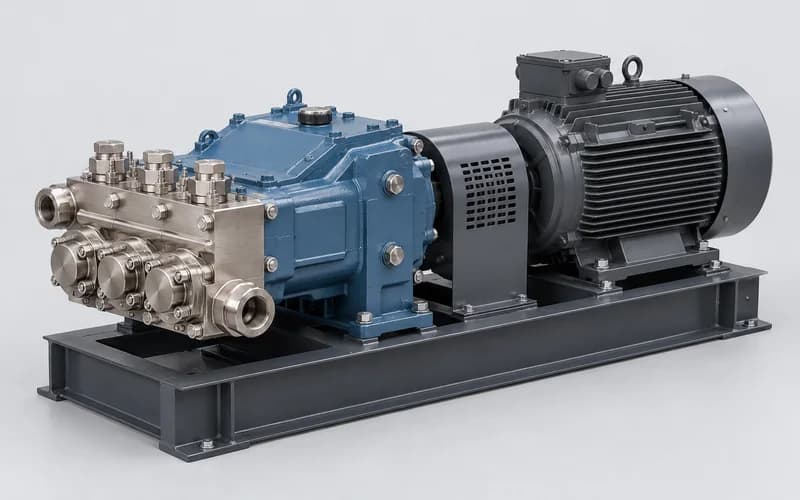
A plunger pump moves fluid by positive displacement, stroke after stroke.
The fluid-end valves, plungers and the power-end bearings each wear in their own pattern, and every pattern shows up in the vibration signature before the pressure drops.
Typical faults
The suction and discharge valves cycle with every stroke. Worn seats or springs change the impact signature and cut volumetric efficiency long before the pump stops holding pressure.
A worn plunger or packing leaks fluid and loads the power end unevenly. The stroke impact pattern shifts, and the pump runs hotter at the same flow.
The crank bearings take the full discharge load on every stroke. Wear raises the high-frequency noise floor, then adds discrete peaks at the bearing characteristic frequencies.
When the suction pressure cannot keep up with the pump, vapour bubbles form and collapse. The spectrum fills with broadband high-frequency noise, and the pump sounds like it is pumping gravel.
Where sensors go
Sensors are bonded next to the bearing seats — no machine modification. Each sensor is bound to its measuring point in the app with a tap, and the gateway is wall-mounted nearby.
DT310 wireless vibration and temperature, 3-axis, 0–6000 Hz. Use DT311, with an external antenna, where a point sits inside an enclosed metal structure.
DMG310 (Ethernet / Wi-Fi): up to 60 sensors each, 60–80 m range in a typical plant (about 300 m line of sight). DMG311 (4G / Ethernet) for sites without Wi-Fi.
How to read a typical spectrum
A healthy plunger pump shows a stroke impact with its harmonic train. Valve wear changes the shape of the impact, and looseness makes the harmonic train uneven. The AI reads the change against the pump's own baseline.
Questions
Can you monitor a high-pressure plunger pump without stopping it?
Yes. Sensors are bonded next to the bearing seats while the pump runs, and there is no machine modification.
How many sensors does one plunger pump need?
Typically 4: power-end crank and fluid-end bearing seats, plus the motor drive end and non-drive end.
How do you tell cavitation apart from valve wear?
Cavitation raises broadband high-frequency noise; valve wear changes the stroke impact pattern. The AI separates the two and names the fault.
Map the measuring points on your equipment before the first call.