
Predictive maintenance for fans
How do you catch a fan blade losing balance before the vibration cracks the bearing?
Fans run for years and fail slowly — dust build-up on blades, wear, and loosening each change the vibration signature first.
A sensor on each bearing seat turns a slow drift into a named fault.
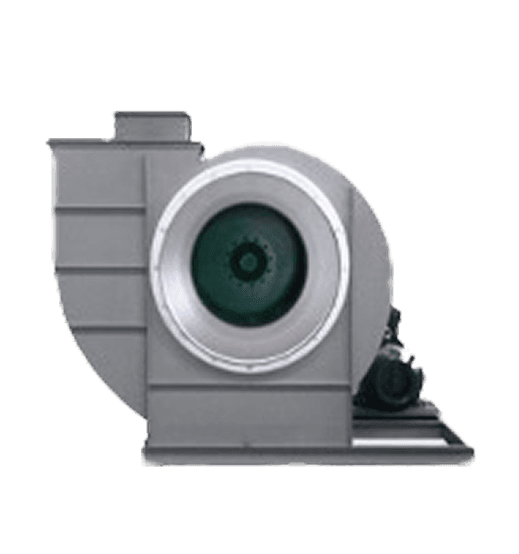
Typical faults
Dust build-up, erosion or a repaired blade changes the mass of the rotor. The spectrum shows a dominant peak at the fan rotation speed.
When the fan shaft and motor shaft are not on one line, a strong peak appears at twice the rotation speed and the coupling loads both bearings.
Fan bearings carry the rotor weight and every unbalance force. Wear raises the high-frequency noise floor, then adds discrete peaks as the fault grows.
A loose foundation or bearing housing produces a train of rotation-speed harmonics in the spectrum.
Where sensors go
Sensors are bonded next to the bearing seats — no machine modification. Each sensor is bound to its measuring point in the app with a tap, and the gateway is wall-mounted nearby.
DT310 wireless vibration and temperature, 3-axis, 0–6000 Hz. Use DT311, with an external antenna, where a point sits inside an enclosed metal structure.
DMG310 (Ethernet / Wi-Fi): up to 60 sensors each, 60–80 m range in a typical plant (about 300 m line of sight). DMG311 (4G / Ethernet) for sites without Wi-Fi.
How to read a typical spectrum
A balanced fan shows a small rotation-speed peak. Blade unbalance makes that peak dominate the spectrum, and its trend over weeks tells you when the blades need cleaning or balancing — before the bearing takes the load.
Questions
How many sensors does one fan need?
Typically 4: two on the fan bearing housings and two on the motor.
Can I monitor a fan inside a duct or enclosure?
Yes — DT311, with an external antenna, is used where a measuring point sits inside an enclosed metal structure.
How often do I get a diagnosis?
On the AI Care plan, Mina runs an automatic diagnosis on every machine each day, and an alert is raised when a change is confirmed. See the help centre for the full cycle.
Map the measuring points on your equipment before the first call.