
Predictive maintenance for belt conveyors
How do you keep a long conveyor running when one pulley bearing can stop the whole line?
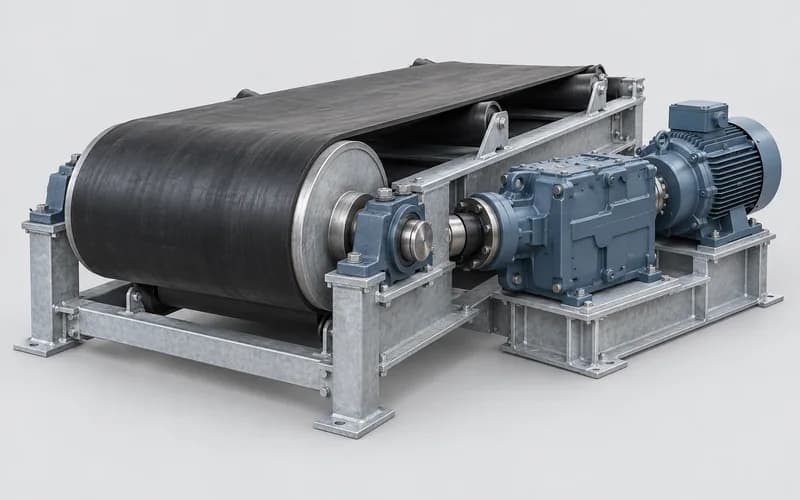
A belt conveyor spreads its bearings along the line — head pulley, tail pulley, drive unit.
A fault at any one of them stops the material flow.
Vibration sensors on the pulley bearing seats and the drive motor catch bearing wear, misalignment and unbalance before the conveyor loses a bearing.
Typical faults
Pulley bearings carry the belt tension and the load. Wear raises the high-frequency noise floor first, then adds discrete peaks at the bearing characteristic frequencies.
A pulley or drive shaft that is not aligned shows a strong peak at twice the rotation speed and loads both bearings unevenly.
Material build-up on a pulley changes its mass. It shows as a rising vibration level and bearing temperature at the pulley bearings, compared at like load on the fixed sampling schedule.
Loose bearing housings or foundations produce a train of rotation-speed harmonics — a pattern that is easy to spot before the housing shakes itself apart.
Where sensors go
Sensors are bonded next to the bearing seats — no machine modification. Each sensor is bound to its measuring point in the app with a tap, and the gateway is wall-mounted nearby.
DT310 wireless vibration and temperature, 3-axis, 0–6000 Hz. Use DT311, with an external antenna, where a point sits inside an enclosed metal structure.
DMG310 (Ethernet / Wi-Fi): up to 60 sensors each, 60–80 m range in a typical plant (about 300 m line of sight). DMG311 (4G / Ethernet) for sites without Wi-Fi.
How to read a typical spectrum
Misalignment in the drive — motor, gearbox and drive pulley shaft — adds a strong peak at twice the shaft speed on the faster shafts. The sensors sample on a fixed schedule and each reading is compared with the conveyor's own baseline, so the warning comes while the bearing still has life left.
Questions
How many sensors does one conveyor need?
A typical start is 6: two on the head pulley bearing seats, two on the tail pulley, and one on each motor end.
Do the sensors survive the conveyor environment?
Sensors are bonded in place and sealed for industrial environments. Where a point sits inside an enclosed structure, DT311 with an external antenna is used.
Which conveyor should I monitor first?
The one you can least afford to stop — the conveyor that feeds the whole line. See the help centre for the measuring-point plan.
Map the measuring points on your equipment before the first call.