
Predictive maintenance for ball mills
How do you catch ring-gear wear before a ball mill stops the whole grinding circuit?
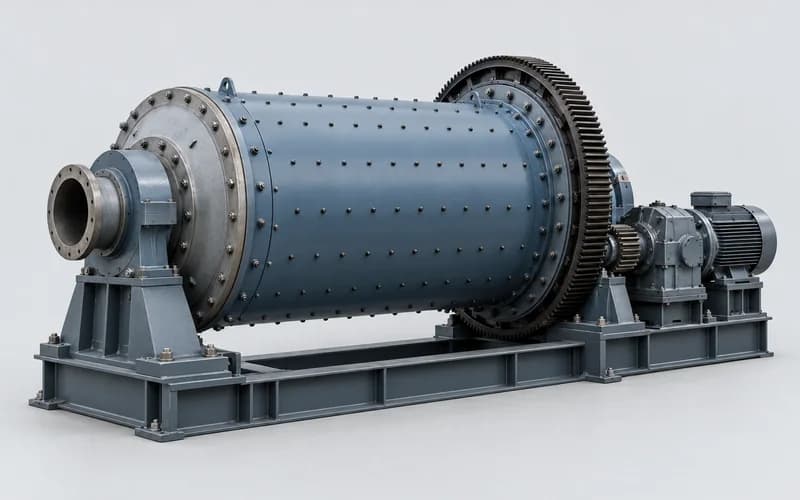
A ball mill turns slowly under a huge load, and its ring gear is the highest-value wearing part after the bearings.
On the drive — motor, gearbox and pinion — gear mesh wear, bearing wear and misalignment each leave a distinct mark in the spectrum.
The slow shell bearings are watched through their vibration and temperature trend, where faults grow slowly but cost the most.
Typical faults
Ring-gear tooth wear shows as a sustained change at the ring-gear mesh frequency and its harmonics, trended against the mill's own baseline at like running state and load. Sidebands at the pinion shaft speed add evidence where the capture resolves them.
On the motor and pinion, bearing wear raises the high-frequency noise floor, then adds discrete peaks at the bearing characteristic frequencies. The mill shell bearings turn too slowly for those peaks to show, so DHMSCare watches their vibration level and temperature against the mill's own baseline.
Misalignment in the drive between motor, gearbox and pinion shows at the drive-side bearing seats — as a strong peak at twice the shaft speed on the faster shafts — and it pushes uneven load onto the ring-gear teeth.
Loose bolts or worn mounting pads on the drive produce a train of shaft-speed harmonics at the pinion and motor bearing seats; on the slow shell bearings, looseness shows as a rising vibration level.
Where sensors go
Sensors are bonded next to the bearing seats — no machine modification. Each sensor is bound to its measuring point in the app with a tap, and the gateway is wall-mounted nearby.
DT310 wireless vibration and temperature, 3-axis, 0–6000 Hz. Use DT311, with an external antenna, where a point sits inside an enclosed metal structure.
DMG310 (Ethernet / Wi-Fi): up to 60 sensors each, 60–80 m range in a typical plant (about 300 m line of sight). DMG311 (4G / Ethernet) for sites without Wi-Fi.
How to read a typical spectrum
On a healthy mill the ring-gear mesh frequency and its harmonics hold steady against the mill's own baseline at like running state and load. Tooth wear shows as a sustained change there, and sidebands at the pinion shaft speed add evidence where the capture resolves them. The slow shell is read through its vibration and temperature trend.
Questions
How many sensors does one ball mill need?
A typical start is 6: two on the pinion shaft bearing seats, two on the mill shell bearings, and one on each motor end.
Is low-speed monitoring different from a fast machine?
Partly. The motor, gearbox and pinion turn fast enough for the spectrum to read the same faults as on any drive. The mill shell turns too slowly for its own frequency lines to show in a capture, so there DHMSCare watches the vibration and temperature trend against the mill's own baseline.
Can I start with just the ring gear drive?
Yes — plans start from one sensor per machine, and you add sensors where a machine has more measuring points.
Map the measuring points on your equipment before the first call.